ESDC Officers and Service Canada Agents Are Not Following ESDC's Own Procedures
ESDC officers and Service Canada agents are not applying ESDC's own procedures consistently. A recent LMIA case on the TFW cap, and internal procedures we obtained by ATIP, show how.

ESDC has internal procedures for a reason: so that an LMIA application is assessed the same way no matter which officer opens the file or which Service Canada agent answers the phone. Increasingly, that is not what employers and consultants are experiencing. In our files, officers and Service Canada support agents are not applying ESDC's own procedures correctly, and where the procedures leave room for discretion, that discretion is being exercised inconsistently and very subjectively.
This is not a complaint about a single officer. It is a pattern, and the most recent example involves the way an employer's TFW cap was assessed.
Why procedures matter
Employers build their recruitment, their workforce plans and their LMIA applications around the rules ESDC publishes and applies. Consultants advise on the same basis. When an officer or a support agent departs from the written procedure, the employer pays for it with a refused or delayed LMIA, lost recruitment time and workers who cannot start. Discretion is part of an officer's job, but discretion is not permission to ignore the procedure or to apply it differently from one file to the next.
A recent example: the TFW cap
An employer was told that their LMIA application was going to be refused because the TFW cap had not been calculated correctly. The stated reason was that the employer had not counted workers on open work permits as temporary foreign workers (TFWs).
The consultant on the file called the Service Canada client support line to confirm. The agent stated that anyone working on a work permit is a TFW. The officer and the support agent reached the same conclusion, and both were wrong.
What ESDC's own procedure says
In July 2026, Balram's Immigration obtained ESDC's internal procedures through an Access to Information and Privacy (ATIP) request. They state clearly who is, and who is not, part of an employer's TFW workforce. This is the relevant section:
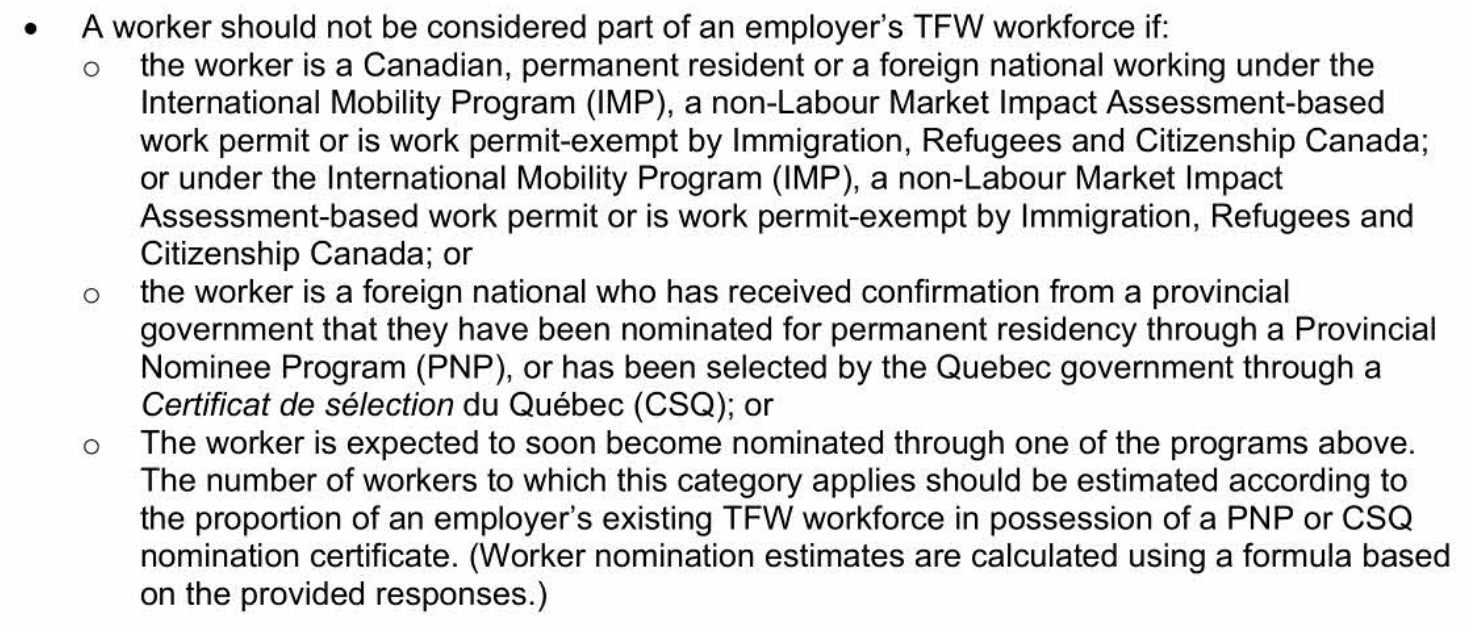
In plain language, a worker should not be counted as part of the employer's TFW workforce if any of the following applies:
- The worker is a Canadian citizen or a permanent resident.
- The worker is a foreign national working under the International Mobility Program (IMP), on a non-LMIA-based work permit, or who is work permit-exempt. This is where open work permit holders fall, for example post-graduation work permit holders and spouses on open work permits.
- The worker is a foreign national who has received confirmation from a provincial government that they have been nominated for permanent residency through a Provincial Nominee Program (PNP), or who has been selected by the Quebec government through a Certificat de selection du Quebec (CSQ).
- The worker is expected to soon be nominated through one of those programs. The number of workers in this category is estimated using the proportion of the employer's existing TFW workforce that holds a PNP or CSQ nomination certificate.
The test is not whether a person holds a work permit. The test is whether the person is working under an LMIA-based work permit. Counting open work permit holders as TFWs inflates the employer's numbers and can push an otherwise compliant employer over the cap, which is exactly what the officer's position would have done.
Two failures, not one
The first failure was the officer's: a refusal was proposed on a reading that contradicts the written procedure. The second was the support line's: when the consultant called to confirm, the agent repeated the same incorrect rule. Support agents are not decision-makers, yet their answers are relayed to employers as if they were official, and an employer who relies on a wrong answer has no recourse.
The TFW definition is only the example. The real problem is that neither the officer nor the support agent applied the procedure that was written to govern the question.
A wider pattern of unfair discretion
This is not the only file where we have seen this. Balram's Immigration has also experienced officers using discretion in ways that appear to disadvantage employers based on factors that have nothing to do with the program criteria. Two employers with materially similar files should receive the same treatment. In our experience, they do not always.
Employers deserve decisions based on the facts of their file and on the written procedures, not on who happens to review the application or who answers the phone.
What employers should do
- Keep a written record of every call, email and reference number when dealing with Service Canada or ESDC. A verbal answer from a support agent is not binding and can be contradicted later.
- If an officer proposes a refusal or raises a concern, ask them to identify in writing the specific procedure or rule they are relying on.
- Respond in writing to any procedural fairness letter, point to the procedure that applies, and ask for the officer's reasoning in writing.
- Calculate and document everything the way ESDC's own procedures require, for example with a worker-by-worker schedule showing each person's status and permit type, with supporting documents.
- Speak to an RCIC or an immigration lawyer early. Reconsideration requests and judicial review are subject to strict time limits.
If your LMIA has been refused or is at risk of refusal and you believe ESDC's procedures were not followed, contact Balram's Immigration Consultancy. We will review your file against ESDC's written procedures.
This article reflects the experience of Balram's Immigration Consultancy on specific files and is general information, not legal advice.